Wild scenes at Cardiff

‘Wild Scenes at Cardiff’ reads the South Wales Echo headline; ‘Blacks Hunted By a Furious Mob’ in the South Wales News. In June 1919, Cardiff was the scene of four days and nights of violent unrest that left three dead, many in hospital, and buildings ransacked and burned by mobs that included soldiers and sailors in uniform, ex-servicemen and women, united in the pursuit of black seamen. Who were these rioters and why they were ‘furious’? Who were their victims? Who did what, when and where? […]

Environmental activism in the 1980s and 1990s

Panel discussion

The present-day ecology movement emerged among the new social movements of the 1960s and 1970s. Its immediate influences were varied. They included the Aldermaston marches of the late 1950s and the impact of the ‘Earth Rise’ photograph taken during the Apollo 11 Moon landing of 1969. The ideas of writers such as Rachel Carson (Silent Spring,1962), E. F. Schumacher, Murray Bookchin and others were also inspirational. In 1972 the ecology movement found early political expression in the PEOPLE […]

Ecology from below

Resisting Enclosure in Rural Somerset and Dorset, 1780-1850

The eighteenth and nineteenth centuries witnessed widespread attempts to ‘privatise’ rural England. By enclosing common land and extinguishing customary rights, rural elites sought to physically reshape and culturally redefine the countryside. In counties such as Somerset and Dorset, labourers increasingly found themselves barred from entering the fields and woodland that had supported their families for generations. Meanwhile, those who attempted to voice their concerns regarding these changes […]

Black2Nature’s Mya-Rose Craig on the conservation sector: its foundations and its racism

Mya-Rose will talk about the foundations of the conservation sector and how racism was pervasive from the beginning and continues to this date. The nineteenth-century context will begin with Darwin and Wallace’s travels around the world. They collected (a euphemism for shooting) thousands of birds, sending the specimens back to the Natural History Museum, as birds “new to man”. Teddy Roosevelt, the US President, declared Native Americans the cause of the decline of animals (regularly shot by his […]

Green Romanticism

The roots of the ecology movement (1750-1900)

Stephen Hunt of the Bristol Radical History Group will start the day with an overview of the ecology movement’s roots in the Romantic era. Industrial capitalism emerged together with the mass exploitation of fossil fuels during the Eighteenth Century. Over the next century it became increasingly apparent that accelerating processes of expansion and extraction threatened many habitats, or even the whole planet. Green Romantic anti-capitalism was an outcome of such processes. The negative social […]

Reflections on Radical Technology in the 1970s

Peter Harper coined the term ‘Alternative Technology’ in 1972 and became Head of Innovation at the Centre for Alternative Technology (CAT). During the mid-1970s, he co-edited Radical Technology, a compendium of ideas for sustainable living. Many of these ideas were showcased at local Comtek (Community Technology) events in Bath, a pioneering national celebration of innovation rolled into lively 1970's pop festivals. "Technology and innovation bring many benefits. They also bring harms, risks and […]

Back to the land

Personal reflections on green and community politics in the 1970s

In 1973 Kath Holden helped found a small commune based on a 135-acre dairy farm in West Wales. She went on to become a smallholder in the same area and disputed her entitlement to common grazing with local farmers, recalling earlier struggles for common-land rights. Later in the decade she volunteered on a farm in the USA, which offered sanctuary for people with mental health difficulties recovering from being in hospital. Inspired by these experiences, she went on to work on one of the earliest […]

Bristol Radical History Festival 2019

Bristol Radical History Group (BRHG) and the Remembering the Real World War I Group (RRWWI) have organised a full programme of events, in collaboration with our hosts at M Shed. Again, we will reveal hidden histories, debate and agitate for a future of better pasts. The 2019 festival has two main themes: 1919: Britain and Ireland in the 'Year of Revolutions' Green History: from 18th Century roots to Extinction Rebellion The aftermath of the First World War was one of the most revolutionary […]

Section: Event Series

Posted: Modified:

The South West Tribunal

Conscientious Objectors in WWII

Foreword During the Second World War, over 60,000 men and 1,000 women applied to register as conscientious objectors (COs) in England, Wales and Scotland. Although this was at least three times as many as in the First World War; it has remained something of an under reported history. The experience of First World War and Second World War COs vary in a number of ways. Sympathetically framed legislation and the fact that the tribunals came under the auspices of the Ministry of Labour rather than […]

The last piece of the jigsaw

Solving the mystery of the forgotten paupers of 100 Fishponds Road

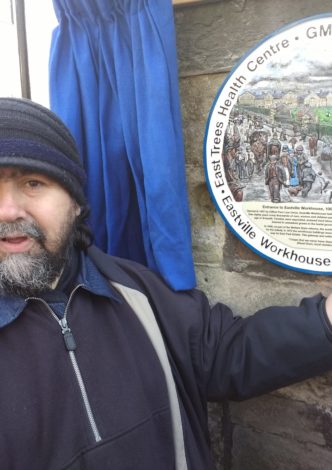
Our dead are never dead to us, until we have forgotten them Introduction One evening in 2010 some members of Bristol Radical History Group (BRHG) were poring over some old maps of Eastville and discovered a forgotten burial ground at Rosemary Green, just round the corner from where they lived. Further investigation showed that the site was in fact the burial ground for Eastville Workhouse at 100 Fishponds Road, an enormous institution that had opened in 1847 and whose buildings were demolished […]